Written by BHPS Medical Team · Medically reviewed by Dr. Edwin Kwon, MD, FACS, board-certified by the American Board of Plastic Surgery · Last reviewed November 25, 2026
If you are considering dermal filler, you have probably wondered how it is actually done. Where does the needle go? Will it hurt? Why do some people bruise and others barely do? The short answer: your results depend less on the brand of filler than on how carefully your provider assesses your face and which technique is chosen for each area.
This guide explains the main injection techniques in plain language, so you know what to ask at your consultation.
The short version
- Providers choose among several techniques depending on the treatment area, the depth needed, and the type of filler.
- Both needles and cannulas are used. Each has trade-offs, and the right choice depends on the area.
- No technique removes risk completely. Choose a licensed, experienced provider and make sure you know the warning signs of complications.
- At BHPS, a medical provider evaluates you before any injectable treatment is approved.
What matters more than the product
Two patients can receive the same filler and end up with very different results. What makes the difference is the plan: how your provider reads your facial structure and the way you are aging, which product is matched to which area (softer fillers for delicate areas, firmer ones where support is needed), how deep the filler is placed, and how much is used. A conservative approach, adding gradually rather than all at once, is often the safest way to a balanced look.
The main filler injection techniques
Your provider may use one technique or combine several in the same visit.
Linear threading
The needle or cannula is placed along a line, such as a fold or the border of the lip, and filler is deposited as the instrument is withdrawn (retrograde) or advanced (antegrade), leaving a thin “thread” of product. It is often used for single lines and for defining the lip border.
Serial puncture
Small amounts of filler are placed at closely spaced points along a line or crease. This allows precise placement with a needle, but it involves more puncture points.
Fanning
After the first pass, the provider changes the angle without fully leaving the skin and deposits another line of filler in a new direction, creating a fan shape. This covers an area with fewer skin entry points and is often used for folds and cheek areas.
Cross-hatching
A set of parallel threads is placed, followed by a second set at right angles, forming a grid. It is often used to cover larger areas evenly.
Small deposits (microdroplet or bolus)
Tiny to small amounts are placed at specific points to add support, projection, or contour, for example in the cheeks or chin, or to refine texture in the lips.
Layering
Filler is placed at more than one depth, or more than one product is used, so that deeper structure and surface smoothness are treated separately.
| Technique | How it works | Often used for |
|---|---|---|
| Linear threading | A line of filler placed along a fold or border | Single lines, lip border |
| Serial puncture | Small amounts at closely spaced points | Fine lines, precise points |
| Fanning | Several lines from one entry point in a fan shape | Folds, cheeks |
| Cross-hatching | Perpendicular grid of threads | Larger areas |
| Small deposits | Individual small placements | Support, contour, lips |
| Layering | Placement at multiple depths | Complex or deeper correction |
This table is a general overview. Your provider decides on technique based on your anatomy and goals.
Needle or cannula?
A needle is sharp and offers fine control, which makes it useful for precise placement and superficial lines. A cannula is a flexible tube with a blunt tip that goes in through a single small entry point. In some areas it can mean fewer puncture sites and less bruising or swelling for some patients. Published research has looked at vascular complications with each, and some studies suggest they may be less common with cannulas, but they can occur with either, and a cannula is not suitable for every area.
There is no single “better” option. A good provider can explain why they chose one for you.
A real patient example
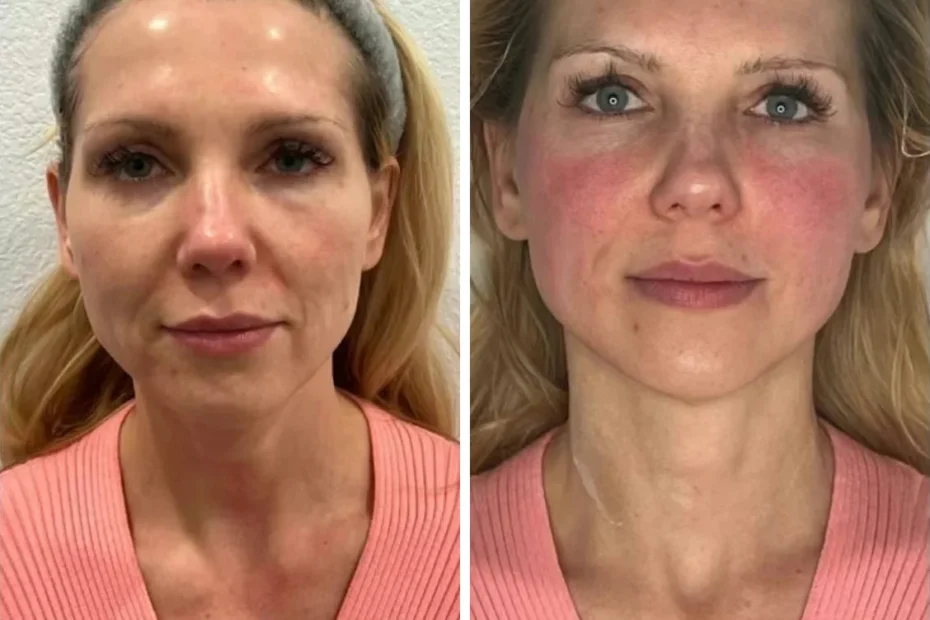
The photos below were taken before treatment and immediately after, on the same day. This patient received 3 syringes of hyaluronic acid filler in the cheek area and the ligament region in front of the ear, combined with Ultherapy. Learn more about fillers.
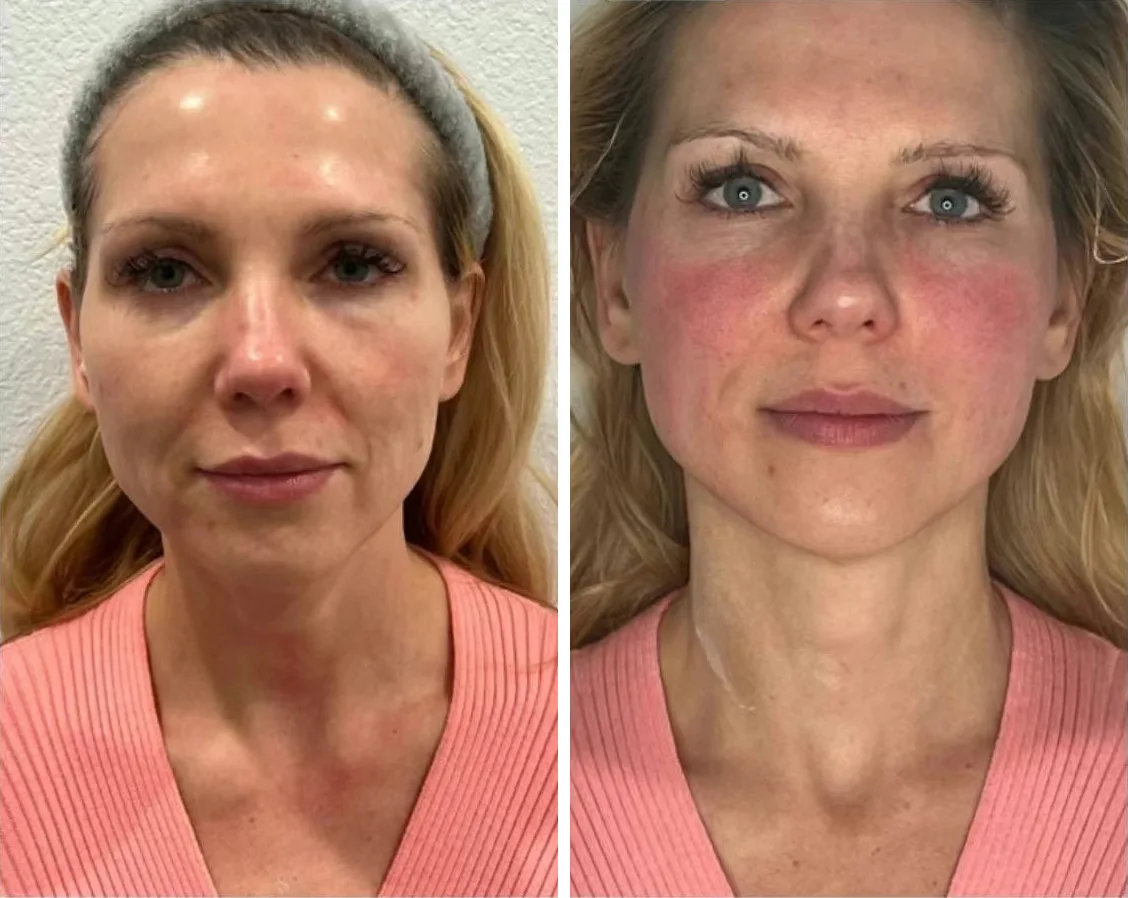
Real BHPS patient, photographed before and immediately after treatment on the same day. Treated with 3 syringes of hyaluronic acid filler in the cheek and the ligament area in front of the ear, plus Ultherapy. Photos are unretouched. Redness and swelling in the “after” photo are temporary. Ultherapy results develop gradually over about 3 months, so this photo does not show its final effect. Individual results vary.
What to expect at your appointment
- Consultation and assessment. Your provider reviews your goals and health history and examines your face. At BHPS, a complimentary consultation is available virtually or in person.
- Planning and comfort. The treatment areas may be marked. Numbing cream is often used, and many hyaluronic acid fillers already contain a local anesthetic.
- Injection. Most people describe pressure or a brief pinch.
- Right after. Mild swelling, redness, tenderness, small bumps, or bruising are common and usually settle over days. You will receive aftercare instructions.
Safety: know the warning signs
Most side effects are mild and short-lived. Rarely, filler can block or compress a blood vessel (vascular occlusion), which is a medical emergency, and in very rare cases it can affect vision.
Contact us immediately, or go to emergency care, if you notice any of the following after treatment:
- Severe or worsening pain
- Skin that turns white, gray, blue, or looks mottled or dusky
- Any change in vision, including blurring or loss of vision (call 911 or go to the nearest emergency room)
Hyaluronic acid fillers can be dissolved with an enzyme called hyaluronidase, and your provider should be trained and equipped to use it if needed. Filler is not recommended during pregnancy or while breastfeeding. For how our clinicians approach vascular complications, see our clinical guideline on filler-induced vascular occlusion.
Who performs your treatment
At BHPS, our injectors are trained in-house by plastic surgeons through hands-on, supervised sessions, repeated over time rather than done once. Our physicians include board-certified plastic surgeons such as Dr. Edwin Kwon, board-certified by the American Board of Plastic Surgery. Every injectable treatment is approved by a medical provider before it begins.
How to choose an injector
- Ask which technique they plan to use and why, and whether they would use a needle or a cannula in your case.
- Ask which products they use and whether they are FDA-approved.
- Ask what happens if there is a complication, whether hyaluronidase is on site, and how to reach the clinic after hours.
- Be cautious of unusually low prices or offers that skip a proper evaluation.
Frequently asked questions
Does filler injection hurt?
Most people feel pressure or a brief pinch. Numbing cream is commonly used, and many hyaluronic acid fillers contain a local anesthetic. Comfort varies by area. Lips are often more sensitive.
How long do results last?
It depends on the product, the area, and the individual. Many hyaluronic acid fillers last from several months to a year or more. Your provider will give an estimate for your plan.
Can filler be reversed?
Hyaluronic acid fillers can be dissolved with hyaluronidase. Other filler types, such as calcium hydroxylapatite or poly-L-lactic acid (for example Radiesse and Sculptra), cannot be dissolved this way, which is one reason to discuss options before treatment.
What is the difference between filler and Botox?
Fillers add volume or smooth static folds. Botox and similar neuromodulators relax the muscles that cause expression lines. They are often used together. Learn more about neuromodulators and fillers.
Which filler do I need?
That depends on the area and goal. See Which Juvéderm filler do I need? and then book a consultation for a personal plan.
Can I have filler if I am pregnant or breastfeeding?
Injection treatment is not recommended during pregnancy or while breastfeeding. Please wait until afterward.
Ready to talk to a provider?
Request a consultation at our Irvine or Beverly Hills clinic. A medical provider reviews your request and goals before any injectable treatment is approved.
· Call (949) 903-9886 · Locations
This article is for general education and is not medical advice. Results vary, and treatment requires evaluation by a licensed provider. See our medical disclaimer.
References
- Review of HA filler injection techniques and skin rejuvenation: https://pmc.ncbi.nlm.nih.gov/articles/PMC7458846
- Alam M, et al. Rates of vascular occlusion associated with using needles vs cannulas for filler injection. JAMA Dermatol. 2021;157(2):174-180. doi:10.1001/jamadermatol.2020.5102
- Injectable filler techniques for facial rejuvenation, volumization, and augmentation. Facial Plast Surg Clin North Am. 2015;23(4):479-88. doi:10.1016/j.fsc.2015.07.004


